Which features does club software for a tennis club need?
Menu
Guide
Which features tennis club software really needs, how it differs from a court booking app and which add-ons fit your club.
Publisher: e-MasterClub – About us · Updated · approx. 8 min read
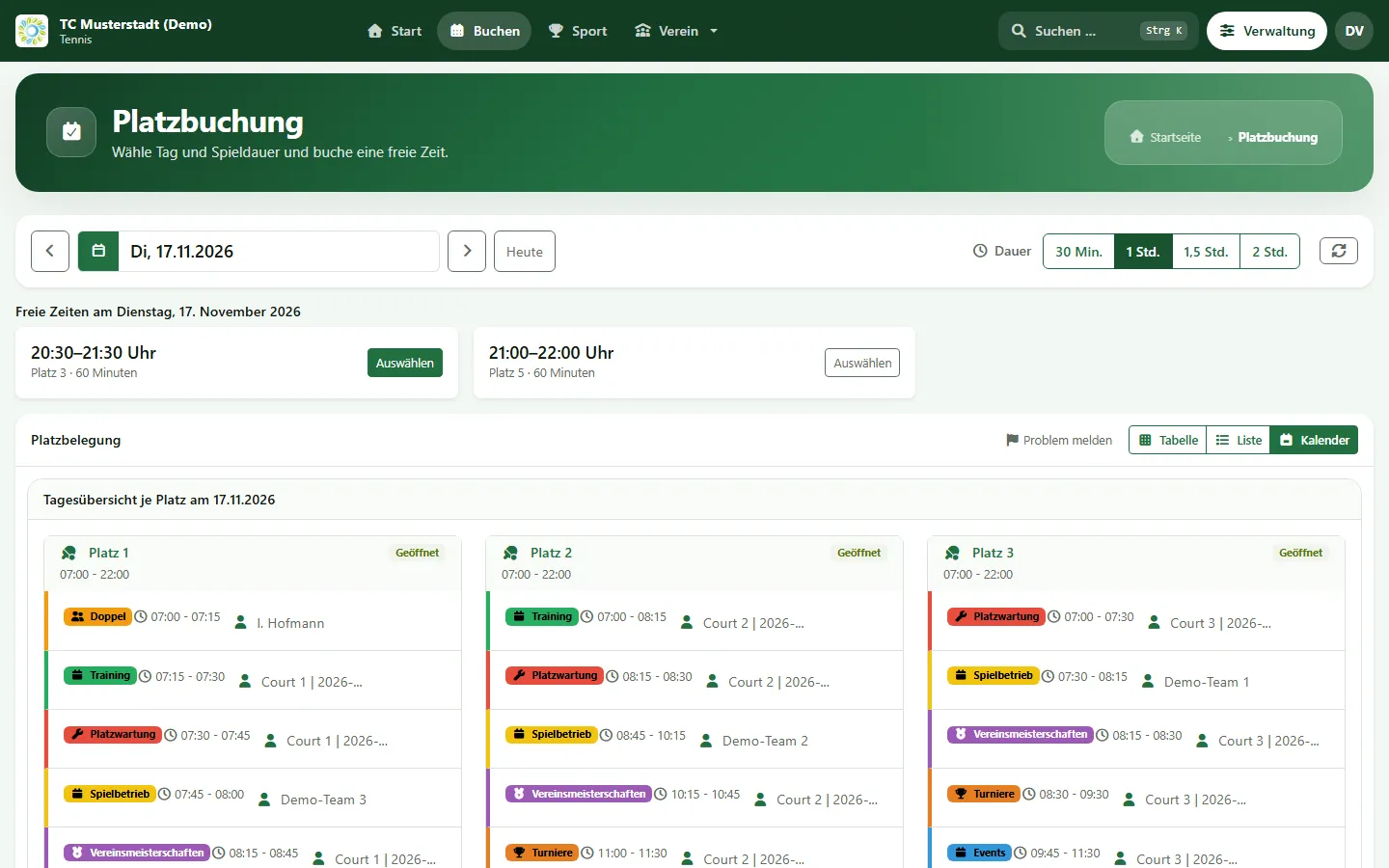
Many clubs start with a booking app because court allocation at the weekend is the most visible problem. The committee's actual workload is often elsewhere, though: membership applications, fee collection, training groups and the question of who may see which data.
| Task | Booking app only | Club software |
|---|---|---|
| Book courts, prevent double bookings | yes | yes |
| Booking rules per membership type | partly | yes, from the member data |
| Membership application with SEPA mandate | no | yes |
| Fee collection by SEPA direct debit | no | yes |
| Roles for committee, sports officer, coach, treasurer | usually admin/member only | yes |
| Training, challenge matches, teams | rarely | depends on the provider |
Master data, families, membership types and departments belong in exactly one place. It is important that the committee, sports officer, coaches and treasurer get their own logins with limited permissions instead of one shared admin login. Look for import and export as CSV or Excel – that is your insurance against later lock-in to a provider.
An occupancy view alone is not enough. The software should check advance booking windows, booking duration, quotas per member, cancellation deadlines and blocked times itself. Otherwise the rules only exist on paper. More on this in the guide Choosing a tennis court booking system.
Fee rates by membership type, price changes with an effective date, a SEPA direct debit export for the bank and handling of returned debits save the treasurer the most time. Ask whether court, guest and training fees run into the same billing.
Under data protection law the club remains the controller. The software should help with that: versioned consents (who agreed to which version and when), processes for access and erasure requests, and a data processing agreement with the provider. Ask for the server location in writing.
Bulk emails sent from the software reach the right audience without every address appearing in CC. Messenger groups can continue alongside; official information and dates, however, should live where the member data is maintained.
You can ask every provider these questions – including us. Ask for written answers and a demo with your own rules.
We deliberately do not publish comparison tables with competitors: the features and prices of other providers change, and we cannot verify them continuously. A weighted scoring matrix to fill in, three-year total cost and a demo script are in the guide comparing club software.
e-MasterClub is club software built specifically for tennis clubs. As of 11 November 2026:
The home page gives an overview of e-MasterClub as club software for tennis clubs. Plans and prices are on the pricing page.
What tennis clubs should look for in a booking system: booking rules, guest players, indoor and outdoor courts, fees and data protection – with a checklist.
Read guide: Choosing a Tennis Court Booking System: Rules, Guests, Indoor Courts and Data ProtectionEight steps from spreadsheets and paper lists to digital club administration: inventory, rules, data protection, data migration and rollout to members.
Read guide: Digitizing a Tennis Club: Step-by-Step Checklist for CommitteesHow a tennis club switches its club software: data export, clean-up, fee codes, booking rules, a short parallel run and data protection during the move.
Read guide: Switching Club Software: Migrating Member Data, Fee Codes and Booking Rules SafelyHow to compare club software fairly: four solution types, a weighted scoring matrix to fill in, three-year total cost and a script for the vendor demo.
Read guide: Comparing Club Software: Solution Types, Scoring Matrix and Total Cost for Tennis ClubsNext step
In the demo we go through the checklist with your booking rules, fee types and roles – no obligation and no credit card.